Drain Cleaning & Sewer Services
From stubborn kitchen clogs to full sewer line repairs, Resolv Services uses professional drain machines and camera inspection technology to restore your drainage system fast.
Fast Answer
Find Drainage Near You
Select your city for local pricing, availability, and service details.
Drain and Sewer Service Costs
| Service | Typical Cost Range |
|---|---|
| Kitchen or bathroom drain cleaning (cable) | $150 - $250 |
| Main sewer line cleaning (cable machine) | $200 - $400 |
| Main line snaking (heavy blockage) | $300 - $500 |
| Sewer camera inspection | $150 - $300 |
| Hydrostatic test (under-slab sewer) | $250 - $450 |
| Sewer cleanout installation | $300 - $600 |
| Sewer line spot repair (accessible) | $800 - $2,500 |
| Sewer line replacement (traditional excavation) | $2,500 - $6,000+ |
Prices reflect our 2025-2026 project records. Final cost depends on pipe location, depth, access conditions, and repair method. We provide a written estimate before work begins.
Signs You Need Drainage Service
When more than one drain in your home is slow at the same time, the problem is likely in the main sewer line rather than in individual branch lines.
Gurgling indicates air trapped in the drain system, usually caused by a partial blockage in the sewer line or a blocked vent pipe on the roof.
A persistent sewer smell signals a dry trap, a cracked sewer line, or a missing cleanout cap that is allowing sewer gas to escape into your living space or yard.
When the main sewer line is blocked, wastewater has nowhere to go and backs up into the lowest drain in the home, typically a floor drain, shower, or ground-floor toilet.
A drain that clogs repeatedly (more than twice per year) usually has an underlying issue such as root intrusion, a pipe belly, mineral scale buildup, or a partially collapsed pipe section.
An unusually green or fast-growing section of grass above your sewer line path can indicate a leak that is fertilizing and watering the soil from below.
A leaking under-slab sewer line can erode the soil supporting your foundation, causing cracks, settling, or uneven floors that worsen over time.
Drain flies breed in the organic buildup inside drain pipes. A sudden increase in these small flies often means there is significant buildup in your drain lines or a break in the sewer pipe under your slab.
Drainage Services We Provide
Drain Cleaning →
We clear kitchen, bathroom, floor, and laundry drains using professional-grade sectional cable machines. For heavy grease buildup and stubborn blockages, we use heavy-duty snake machines with root-cutting attachments to restore full flow.
Sewer Cleaning →
Main sewer line blockages cause system-wide slow drains and sewage backups. Our RIDGID K-5208 drum machine handles pipes from 2 to 8 inches in diameter with root-cutting attachments that slice through tree root intrusions. We follow up with camera inspection when recurring issues are suspected.
Sewer Line Repair and Replacement →
When cleaning reveals structural pipe damage — cracks, collapsed sections, bellies, or offset joints — we provide traditional excavation and section replacement. Every repair includes a post-repair camera inspection to verify the work, and we help you choose the method that balances cost, disruption, and long-term reliability.
Sewer Cleanout Installation →
A sewer cleanout provides direct ground-level access to your sewer line, making future cleaning and inspections faster, more effective, and less expensive. Many older homes were built without cleanouts. Installation typically takes 2 to 3 hours and pays for itself the next time you need drain service.
Camera Inspection →
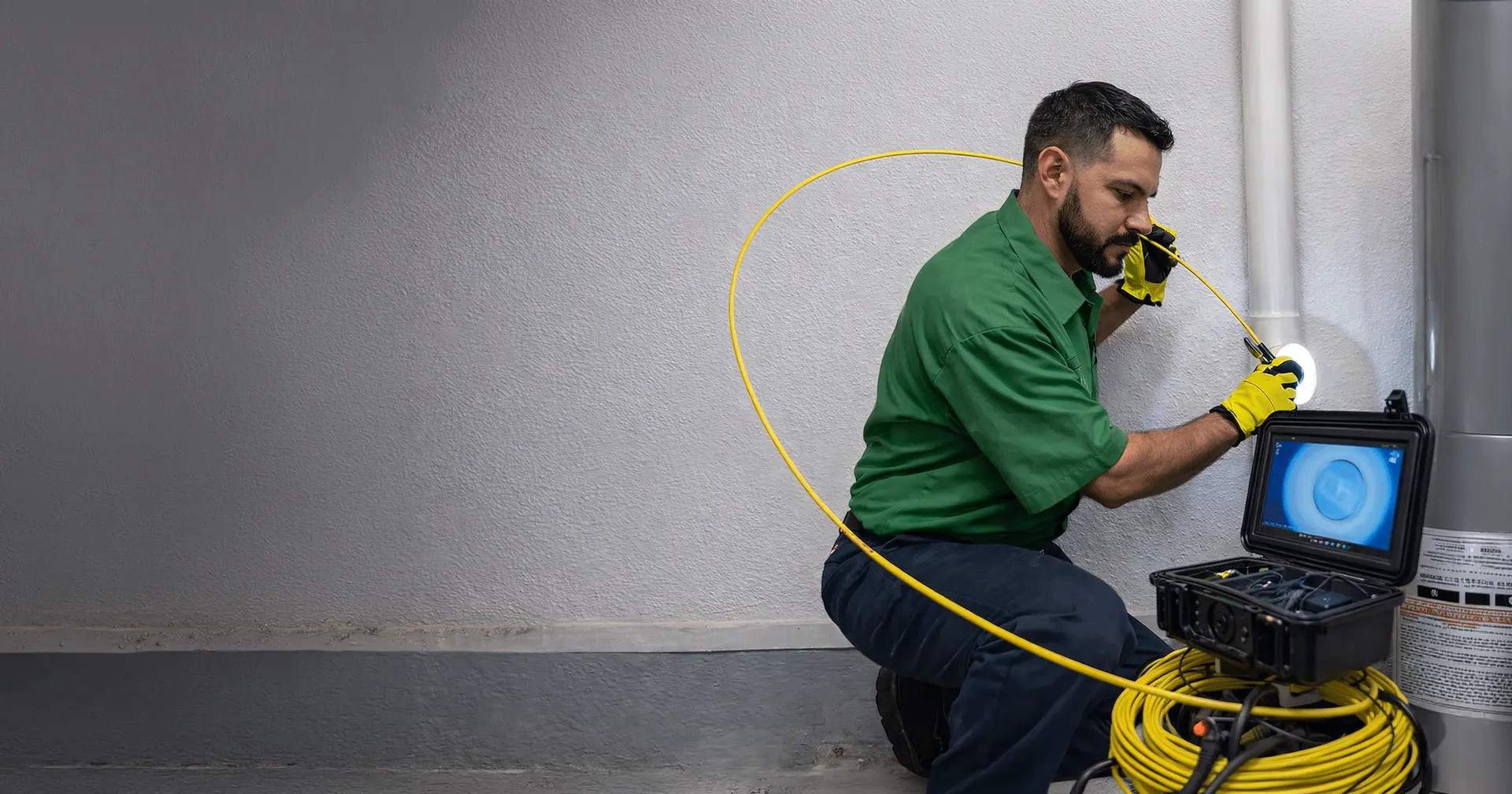
Our RIDGID SeeSnake camera system feeds a high-resolution camera into the pipe, transmitting real-time video with a built-in location transmitter that marks the exact surface location of any problems. We recommend camera inspections before home purchases, after recurring clogs, and before any sewer repair to ensure we target the right section of pipe.
Hydrostatic Test →
Hydrostatic testing determines whether your under-slab sewer lines are leaking beneath the foundation. We plug the main sewer line, fill the drain system with water to slab level, and monitor for 15 to 30 minutes. A water level drop confirms a leak. This test is commonly required during real estate transactions, foundation evaluations, and insurance claims.
Drain Cleaning vs. Sewer Line Repair — What You Actually Need
Not every slow drain means you need a new sewer line, and not every clog is solved by a $20 bottle of chemical cleaner. The key is accurate diagnosis. A single slow drain is usually a localized blockage in the branch line — a cable machine clears it in 30 minutes. Multiple slow drains throughout the house point to a main sewer line issue that needs a more powerful approach.
If your drains clog more than twice a year in the same location, something structural is likely going on: tree root intrusion, a pipe belly that traps debris, mineral scale narrowing the pipe, or a partially collapsed section. A camera inspection ($150 to $300) reveals the cause definitively. Sometimes a thorough snaking clears the buildup and the pipe is structurally sound — problem solved for months. Other times, the camera shows a cracked, offset, or collapsed pipe that no amount of cleaning will fix.
When repair is needed, the method depends on the pipe's material, depth, and the extent of damage. Spot repairs work for isolated failures. For full line replacements, traditional excavation with new PVC or HDPE pipe is the most reliable approach. We explain the options, the costs, and the trade-offs so you can make the right call for your situation.
Chemical Drain Cleaners vs. Professional Drain Cleaning
| Factor | Chemical Drain Cleaners | Professional Drain Cleaning |
|---|---|---|
| Effectiveness on Full Clogs | Often ineffective | Clears complete blockage |
| Effect on Pipes | Corrosive — damages older cast iron and clay tile pipes | Non-damaging — mechanical cleaning only |
| Hard Water Scale Removal | Cannot dissolve mineral deposits | Cable machine removes scale and buildup |
| Recurring Clogs | High — does not remove full buildup | Low — removes blockage and wall buildup completely |
| Root Intrusion | No effect on roots | Root-cutting attachments on cable machines clear roots |
| Diagnostic Ability | None — cannot identify cause | Camera inspection identifies underlying pipe damage |
| Safety | Caustic chemicals — burn and fume risk | No chemicals used — safe for your pipes and family |
| Cost per Incident | $5-$15 per bottle (repeated use) | One-time service fee with lasting results |
Keeping Drains Clear in the Permian Basin
The Permian Basin's water carries enough dissolved calcium and magnesium to leave visible white deposits on any surface it touches — and inside drain lines, those deposits accumulate year after year. Chemical drain cleaners are useless against calcium carbonate deposits — and they actively damage older cast iron and clay tile pipes. The only effective removal method is professional mechanical cleaning with a cable machine. For homes with chronic hard water scale, we recommend professional drain maintenance every 1 to 2 years as prevention rather than waiting for a full backup.
Grease is the other major culprit. Kitchen grease solidifies inside drain lines and combines with hard water minerals to form rock-hard scale that narrows the pipe over time. Never pour grease down a drain — let it cool and dispose of it in the trash. Root intrusion is a third factor: desert-adapted plants like mesquite send roots deep in search of moisture, and a sewer line joint or crack is a prime target. Homes with large trees near sewer lines should have annual camera inspections to catch root intrusion before it becomes a full blockage.
How Our Drainage Process Works
Call & Describe
Tell us what's happening — slow drain, backup, odor, or multiple fixtures affected. We dispatch accordingly.
Same-Day Service
For active backups, we prioritize your call. Our trucks carry drain machines and cameras.
Camera Diagnosis
We run a sewer camera to see the actual condition of the line. You see the footage with us — no guessing, no unnecessary work.
Clear the Line
We snake the line with a professional cable machine to clear the full blockage, not just the symptom.
Verify & Recommend
Post-clearing camera run to confirm the line is clean and identify any damage that may need future attention.
Documentation & Warranty
Drain cleaning backed by a 120-day guarantee. Sewer repairs warranted in writing. You get the camera footage for your records.
24/7 Emergency Drainage Service
What Counts as an Emergency
- ●Sewer backing up into the house through toilets, tubs, or floor drains
- ●Raw sewage visible outside near the cleanout or in the yard
- ●Multiple drains in the home clogged simultaneously
- ●Toilet overflowing and won't stop despite shutoff attempts
- ●Foul sewer gas smell inside the home (potential health hazard)
What to Do Right Now
Shut off the water supply to the affected area if safe. If you smell gas, evacuate and call 911 first. For sewer backups, stop all water use in the building. Then call us.
(432) 290-8511Professional Drain Cleaning That Lasts
A clogged drain costs $130 to $400 to clear professionally. That investment solves the problem completely, unlike store-bought chemical drain cleaners that provide temporary relief and corrode your pipes in the process. Hard water areas face a specific challenge: calcium and magnesium deposits combine with grease, soap, and hair to form rock-hard scale inside drain lines that chemical products cannot dissolve.
Resolv Services (TX Plumbing License #42668) uses professional-grade drain machines and sectional cable systems to clear clogs in kitchen drains, bathroom drains, floor drains, laundry lines, and main sewer lines. According to the Institute for Business & Home Safety, water damage from backed-up drains and burst pipes is the most common homeowner insurance claim, averaging $11,098 per incident. A $150 to $400 drain cleaning prevents thousands in potential damage.
Sewer Line Services — From Cleaning to Replacement
Your sewer line carries all wastewater from your home to the city main. When it fails, the results range from slow drains throughout the house to raw sewage backing up into your lowest fixtures — a health hazard requiring emergency service. Common causes of sewer line problems include tree root intrusion, soil shifting that creates bellies or offsets in the pipe, and deterioration of older pipe materials like clay tile and cast iron.
We clean sewer lines with heavy-duty cable machines, then perform a camera inspection to assess the pipe's structural condition. When repair or replacement is necessary, we offer spot repairs and full line replacement with PVC or HDPE pipe depending on the pipe material, depth, and extent of damage.
Our RIDGID SeeSnake camera system is the most reliable way to see what is happening inside your drain and sewer lines without digging. The system feeds a high-resolution camera on a flexible push rod into the pipe, transmitting real-time video to a monitor. A built-in sonde (location transmitter) lets us mark the exact surface location of any problems we find — whether that is a root intrusion, collapsed section, belly, or offset joint.
We record the full inspection on video for your records, which is valuable documentation for insurance claims, real estate transactions, and contractor communication. Camera inspections are recommended before purchasing a home, after recurring clogs, when drains are slow throughout the house, and before any sewer repair to ensure we target the right section of pipe.
Hydrostatic testing determines whether your under-slab sewer lines are leaking beneath your home's concrete foundation. The process works by plugging the main sewer line at the cleanout, filling the drain system with water to slab level, and monitoring the water level for 15 to 30 minutes. If the water level drops, it confirms that a leak exists in the under-slab piping.
A leaking sewer line under your foundation can erode the supporting soil, attract pests, create unsanitary conditions, and contribute to foundation movement. If the initial test reveals a leak, we follow up with isolation testing — testing individual sections of the sewer system — to pinpoint the exact location of the failure. We then recommend the most cost-effective repair method: spot repair through the slab, pipe reroute above the slab, or full line replacement.
This testing gives homeowners and buyers definitive information about the condition of their under-slab plumbing.
Commercial kitchens and restaurants generate far more grease, food waste, and organic matter than residential plumbing systems. Health department regulations typically require grease trap maintenance and drain cleaning on a quarterly schedule. Failure to comply results in fines, mandatory closures, and — more practically — sewer backups during business hours that shut down your kitchen and cost you revenue.
Resolv Services provides scheduled commercial drain maintenance programs that keep your kitchen compliant and your drains flowing. We clean floor drains, prep sink lines, and main sewer connections using commercial-grade equipment, and we document every service for your health department records. For facilities with persistent grease issues, we recommend professional drain cleaning on a semi-annual basis to prevent the slow buildup that leads to sudden blockages.
Common Questions About Drainage
Based on our 2025-2026 project records, a standard kitchen or bathroom drain cleaning with a cable machine costs $150 to $250. Main sewer line cleaning runs $200 to $400. Heavy blockages requiring extended snaking run $300 to $500. We provide a written estimate before starting any work. Call (432) 290-8511 for your free estimate.
For most homes in hard water areas, we recommend professional drain cleaning every 1 to 2 years as preventive maintenance. Homes with large trees near sewer lines, older clay or cast iron pipes, or a history of recurring clogs may benefit from annual service. Commercial kitchens and restaurants should have drains and grease traps cleaned quarterly to comply with health department regulations.
Recurring clogs usually indicate a deeper issue beyond a simple blockage. Common causes include tree root intrusion into sewer lines, a belly or sag in the pipe that traps debris, buildup of hard water mineral scale combined with grease, or a partially collapsed section of pipe. A camera inspection ($150 to $300) is the fastest way to identify the root cause and determine whether cleaning, repair, or replacement is the right long-term solution.
A hydrostatic test checks your under-slab sewer lines for leaks by filling the drain system with water and monitoring the level for 15 to 30 minutes. If the water level drops, it confirms a leak exists beneath your foundation. Hydrostatic testing is commonly required during home sales, foundation evaluations, and insurance claims. We recommend it for any home over 15 years old where soil movement may have damaged the under-slab piping.
If your home does not have an accessible sewer cleanout in the yard, we strongly recommend adding one. A cleanout provides direct access to your sewer line from ground level, making drain cleaning and camera inspections faster, more effective, and less expensive. Many older homes were built without cleanouts. Installation costs $300 to $600 and typically takes 2 to 3 hours.
We use professional-grade sectional cable machines and drum machines with various cutting heads — including root-cutting attachments for tree root intrusion. Our RIDGID K-5208 drum machine handles pipes from 2 to 8 inches in diameter. We also carry a RIDGID SeeSnake camera system for inspecting pipes before and after cleaning to ensure the blockage is fully cleared.
Yes. A sewer backup is a health hazard that requires immediate attention. Raw sewage backing into your home exposes your family to harmful bacteria and can cause extensive property damage. Resolv Services offers same-day emergency sewer service. Call (432) 290-8511 any time, including nights, weekends, and holidays.
Drain snaking feeds a rotating steel cable with a cutting head into the pipe to break through the blockage and restore flow. Different cutting heads are used depending on the type of blockage — grease, roots, or debris. For main sewer lines, we use heavy-duty drum machines that can handle pipes up to 8 inches in diameter. A camera inspection after cleaning confirms the line is fully cleared and identifies any structural issues that may need future attention.
A camera inspection is the definitive answer. Signs that suggest structural sewer line problems include recurring backups (more than twice per year), multiple slow drains, sewage odors in the yard, foundation settling near plumbing, and lush green patches over the sewer line. The camera reveals whether the issue is buildup that cleaning can resolve or structural damage — cracks, bellies, offsets, or collapse — that requires repair or replacement.
Absolutely. Tree roots seek moisture and nutrients, and a sewer line joint or crack is a prime target. Once a root enters the pipe, it grows rapidly, catching debris and eventually blocking the line entirely. In the Permian Basin, mesquite and other desert-adapted species send roots deep in search of water, making root intrusion one of the most common sewer line problems we encounter. Regular camera inspections and root-cutting with our cable machines are the most effective prevention and treatment.
Need Drainage? Let's Talk.
Get a written estimate for drainage — no obligation, no surprises.
TX #42668 — Serving the Permian Basin