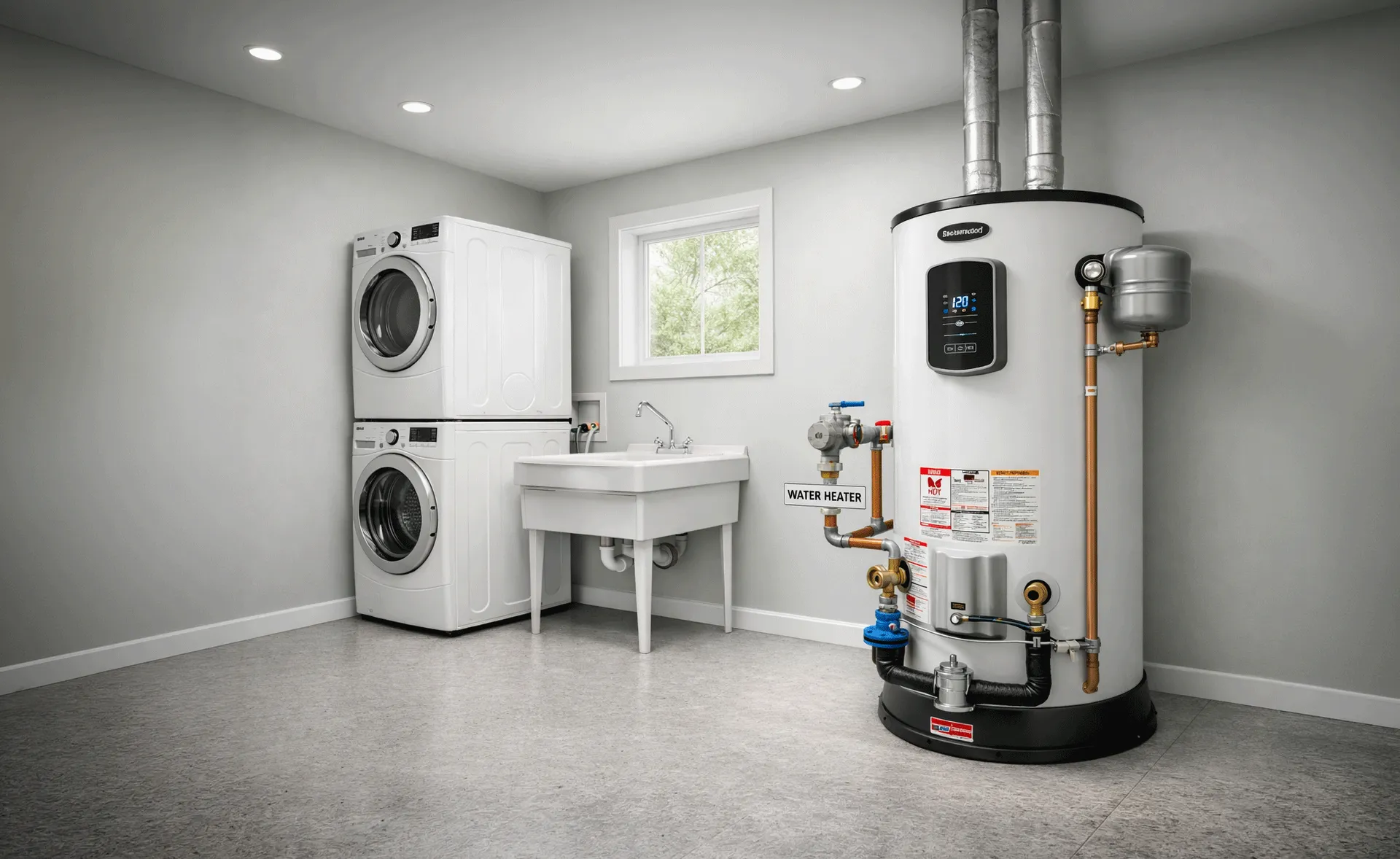
Water Heater Installation, Repair & Maintenance
Tank and tankless water heater experts with 25+ years of experience. Resolv Services installs, repairs, and maintains all major brands with upfront pricing and same-day availability.
Fast Answer
Find Water Heaters Near You
Select your city for local pricing, availability, and service details.
Water Heater Service Costs
| Service | Typical Cost Range |
|---|---|
| Tank water heater replacement (40-50 gal, gas) | $900 - $1,500 |
| Tank water heater replacement (40-50 gal, electric) | $800 - $1,300 |
| Tankless water heater installation (gas) | $2,500 - $4,500 |
| Tankless water heater installation (electric) | $2,000 - $3,500 |
| Water heater repair (thermostat, element, valve) | $150 - $400 |
| Anode rod replacement | $150 - $300 |
| Annual tank flush and maintenance | $100 - $175 |
| Tankless descaling service | $150 - $250 |
| Expansion tank installation | $150 - $300 |
Prices reflect our 2025-2026 project records. Actual cost depends on unit brand, home configuration, and code requirements. We provide a written estimate before work begins.
Signs You Need Water Heaters Service
Brown or rust-colored hot water (but clear cold water) usually means the tank lining has failed and the steel shell is corroding from the inside.
These noises come from steam bubbles forming under a thick sediment layer at the bottom of the tank, a sign the unit needs flushing or is near end of life.
Puddles around the water heater indicate a tank leak, a failing T&P valve, or a loose fitting that needs immediate attention to prevent water damage.
Fluctuating hot water temperature points to a failing thermostat, a damaged dip tube, or a heating element issue that a technician can diagnose in minutes.
Tank water heaters in the Permian Basin typically last 8 to 12 years. Units older than 10 years are at higher risk of sudden failure, especially without regular maintenance.
A sudden increase in your gas or electric bill without a change in usage often means the water heater is working harder due to sediment buildup or a failing component.
Rust on the tank exterior, around fittings, or on the flue indicates moisture exposure and potential structural weakness that can lead to a tank rupture.
Error codes on a tankless water heater often signal scale buildup in the heat exchanger, an ignition failure, or a flow sensor issue that requires professional descaling or repair.
Water Heaters Services We Provide
Water Heater Repair →
Our licensed plumbers diagnose and repair all tank water heater failures, including faulty thermostats, burned-out heating elements, leaking T&P valves, and corroded anode rods. Most repairs are completed in a single visit with parts carried on our trucks.
Water Heater Replacement →
When repair costs exceed 50% of a new unit or the tank is past its service life, replacement is the smart move. We size every replacement to your household's peak demand, handle code-compliant installation with expansion tanks and proper venting, and coordinate permits and inspections.
Water Heater Maintenance →
Annual maintenance extends your water heater's life by 3 to 5 years. Our service includes a full tank flush, anode rod inspection and replacement, burner and ignition system cleaning, gas connection leak testing, and T&P valve safety check.
Tankless Water Heater Repair →
Tankless systems are reliable but not maintenance-free. We troubleshoot error codes, replace failed ignition assemblies, clean flame sensors, repair flow control valves, and resolve temperature fluctuation issues across all major brands including Rinnai, Navien, and Rheem.
Tankless Water Heater Replacement →
Upgrading to tankless or replacing an aging unit requires precise load calculation, proper gas line sizing, and code-compliant venting. We handle the full scope — removal, installation, gas and electrical connections, and city inspection coordination — typically in 4 to 8 hours.
Descale Tankless Water Heater →
Hard water in West Texas deposits calcium and magnesium scale inside tankless heat exchangers faster than almost anywhere in the country. Annual descaling with a food-grade vinegar solution restores flow, prevents error codes, and protects your investment.
Repair or Replace? How to Decide
The 50% rule is the industry standard: if a single repair costs more than half the price of a new unit, replacement is the better investment. But age matters too. A 3-year-old water heater with a $350 thermostat repair has years of life left. A 10-year-old tank unit with the same problem is statistically close to additional failures — the repair buys time, but not much.
Tank water heaters typically last 8 to 12 years with maintenance. Tankless units last 15 to 20 years. If your tank unit is past year 8 and showing symptoms — rusty water, inconsistent temperature, visible corrosion — we generally recommend replacement rather than sinking repair dollars into aging equipment. We walk through the math with you during every consultation so the decision is clear, not pressured.
Consider the full picture: a new high-efficiency unit can cut water heating costs by 10% to 34% depending on the type. Factor in the remaining repair risk on an old unit versus the warranty protection on a new one. We provide a side-by-side cost comparison so you can see the 5-year total cost of ownership for each option.
Tank vs. Tankless Water Heaters
| Feature | Tank Water Heater | Tankless Water Heater |
|---|---|---|
| Upfront Cost (installed) | $800 - $1,500 | $2,000 - $4,500 |
| Monthly Energy Cost | Higher — heats water 24/7 | Lower — heats on demand only |
| Typical Lifespan (with maintenance) | 8-12 years in hard water | 15-20+ years in hard water |
| Hot Water Supply | Limited by tank size (40-75 gal) | Unlimited continuous flow |
| Space Required | Large — floor or utility closet | Compact — wall-mounted |
| Hard Water Maintenance | Annual tank flush | Annual descaling required |
| Energy Savings | Baseline | 24-34% reduction (DOE data) |
| Best For | Lower budget, simple replacement | Long-term savings, high-demand homes |
Water Heater Maintenance in the Permian Basin
The Permian Basin has some of the hardest water in the country — mineral concentrations that the Water Quality Association classifies as very hard and that rank among the highest for any metro area in Texas. That mineral load is the single biggest threat to water heater longevity in this region. In tank units, calcium carbonate settles at the bottom and hardens into a layer that insulates the burner from the water. The burner runs longer, the tank overheats at the bottom, and the glass lining cracks. In tankless units, scale restricts the heat exchanger until the unit triggers a fault code and shuts down.
Annual maintenance is non-negotiable here. For tank units, that means a full drain-and-flush to remove sediment, plus an anode rod inspection — the sacrificial rod that protects the steel tank from corrosion. Once the anode rod is consumed, the tank itself starts corroding. For tankless units, annual descaling with a food-grade vinegar solution clears mineral deposits from the heat exchanger and restores factory efficiency. Pairing any water heater with a whole-home water softener dramatically extends equipment life and reduces energy costs.
How Our Water Heaters Process Works
Call & Describe
Tell us the symptoms — no hot water, strange noises, leaking. We dispatch a technician with the right tools and common parts.
Inspect & Diagnose
We check the unit's age, condition, and performance. For repairs, we identify the failed component. For replacements, we assess sizing needs.
Recommend — Repair or Replace
If the unit is repairable and worth fixing, we repair it. If it's past its useful life, we recommend replacement and explain why.
Written Estimate
You get a clear price before any work begins. For replacements, we walk you through brand options, efficiency ratings, and warranty differences.
Install & Test
New units installed to code with proper venting, connections, and expansion tanks. We test the entire system before leaving.
Documentation & Warranty
Manufacturer warranty registered. Our labor warranty documented in writing. We show you how to maintain the unit for maximum lifespan.
24/7 Emergency Water Heaters Service
What Counts as an Emergency
- ●Water heater leaking or flooding the area around the unit
- ●Gas smell near the water heater (evacuate first, call 911, then call us)
- ●Complete loss of hot water in the home
- ●Relief valve discharging water continuously
- ●Electrical burning smell from an electric water heater
What to Do Right Now
Shut off the water supply to the affected area if safe. If you smell gas, evacuate and call 911 first. For sewer backups, stop all water use in the building. Then call us.
(432) 290-8511Tank and Tankless Water Heater Experts
Water heating accounts for roughly 20% of a home's total energy costs according to the U.S. Department of Energy, making it the second-largest energy expense after HVAC. Choosing the right system and maintaining it properly saves hundreds of dollars per year.
Resolv Services (TX Plumbing License #42668) installs, repairs, and replaces both tank and tankless water heaters from Rheem, Rinnai, AO Smith, Bradford White, and Navien. Our licensed plumbers size every unit to match your household's peak demand, fuel source, and the hard water conditions common across West Texas. We provide a written estimate before any work begins and handle all permit coordination.
Why Proper Sizing Matters
An undersized water heater runs out of hot water during peak demand. An oversized unit wastes energy heating water you never use. We calculate peak demand based on fixture count, number of occupants, and simultaneous use patterns.
For tankless installations, we factor in incoming water temperature — groundwater in the Permian Basin drops to the mid-40s Fahrenheit during winter, which directly affects the unit's flow rate and temperature rise. Proper sizing is the difference between a system that performs flawlessly and one that disappoints from day one.
We install and service all major water heater brands. Rheem Performance and Performance Plus series are our most-installed tank units — reliable, well-priced, and widely available for fast replacement. Rinnai RU series tankless units are our top recommendation for homes upgrading from tank to tankless, offering condensing efficiency and Wi-Fi monitoring.
AO Smith Signature and ProLine series provide solid mid-range tank options with long warranty coverage. Bradford White Defender Safety System units feature a sealed combustion chamber that prevents flammable vapor ignition — a safety feature we recommend for water heaters installed in garages. Navien NPE-A2 condensing tankless units deliver the highest efficiency ratings in our lineup at 0.97 UEF, making them ideal for homeowners focused on long-term energy savings.
We recommend specific brands and models based on your home's demand profile, fuel type, and budget — not manufacturer incentives.
Water heater efficiency is measured by the Uniform Energy Factor (UEF), which replaced the older Energy Factor (EF) rating in 2017. A higher UEF means more of the fuel's energy goes into heating water rather than being lost. Standard gas tank water heaters have UEF ratings of 0.58 to 0.65.
High-efficiency condensing tank models reach 0.80 or higher. Gas tankless units range from 0.82 for non-condensing models to 0.97 for condensing units like the Navien NPE-A2. Electric tank water heaters have UEF ratings of 0.92 to 0.95 because there is no combustion loss, but electricity costs more per BTU than natural gas in most of West Texas.
Heat pump water heaters achieve UEF ratings of 3.0 or higher by extracting heat from surrounding air, but they require a warm, spacious installation area and are less common in this region. We calculate the estimated annual operating cost for each option during your consultation so you can compare total cost of ownership, not just sticker price.
For tank water heaters, sizing is based on First Hour Rating (FHR) — the number of gallons of hot water the unit can deliver in the first hour of use. A family of 2 to 3 typically needs a 40-gallon tank with an FHR of 50 to 60 gallons. Families of 4 to 5 should look at 50- to 65-gallon tanks with an FHR of 70 to 80 gallons.
Larger households or homes with multiple bathrooms may need a 75-gallon unit or dual tank setup. For tankless water heaters, sizing is based on flow rate (gallons per minute) and temperature rise. You need to know how many fixtures you will run simultaneously and how much the unit needs to raise the water temperature.
In West Texas, incoming groundwater ranges from the mid-40s in winter to the low 70s in summer. A single shower uses 2.0 to 2.5 GPM. Running two showers and a kitchen sink simultaneously requires 6.0 to 7.5 GPM — which demands a high-capacity unit like the Rinnai RU199 (11 GPM max flow rate).
We perform this calculation during every consultation to match the right unit to your actual usage.
The Permian Basin sits on ancient seabed formations rich in calcium, magnesium, and other dissolved minerals. Municipal water treatment removes contaminants but does not soften the water. Dissolved hardness minerals arrive at the tap in concentrations that are roughly 3 to 5 times the national average — above 250 ppm in most Odessa and Midland neighborhoods.
This hard water creates three specific problems for water heaters. First, sediment accumulation in tank units creates an insulating layer between the burner and the water, forcing the unit to work harder and shortening its life from the national average of 10 to 15 years to roughly 8 to 10 years locally. Second, scale buildup inside tankless heat exchangers restricts water flow and reduces heat transfer efficiency, eventually triggering error codes that shut the unit down.
Third, accelerated anode rod consumption means the sacrificial rod that protects the tank from corrosion may be depleted in 2 to 3 years instead of the typical 4 to 5 years. A whole-home water softener installed upstream of the water heater addresses all three issues and is the single best investment for extending equipment life in this region.
Common Questions About Water Heaters
A tank water heater in a hard water region like the Permian Basin typically lasts 8 to 12 years, somewhat shorter than the national average of 10 to 15 years, because the area's very-hard water accelerates sediment buildup and anode rod consumption. Tankless units last 15 to 20 years with annual descaling. Annual maintenance is the single most effective way to maximize lifespan regardless of which type you own.
Based on our 2025-2026 project records, a standard 40- to 50-gallon tank water heater replacement costs $900 to $1,500 installed. Tankless water heater installations range from $2,000 to $4,500 depending on the brand, fuel type, and whether gas line or venting upgrades are needed. We provide a free written estimate before starting any work. Call (432) 290-8511 for yours.
For many homeowners, yes. The energy savings of 24% to 34% are documented by the U.S. Department of Energy, the lifespan is significantly longer, and you never run out of hot water. However, hard water regions require a commitment to annual descaling to keep the unit running properly. Pairing a tankless unit with a whole-home water softener maximizes both efficiency and equipment life. We provide a cost comparison during every consultation so you can see the numbers for your specific situation.
A straightforward tank-to-tank replacement usually takes 2 to 4 hours. Upgrading from a tank to a tankless system takes longer, typically 4 to 8 hours, because it often requires upgrading the gas line size, adding a dedicated electrical circuit, and installing new stainless steel venting. We provide a detailed time estimate before work begins so you can plan accordingly.
We recommend flushing tank water heaters annually in hard water areas. Nationally, manufacturers suggest every 2 to 3 years, but mineral loads above 15 grains per gallon demand a more frequent schedule. Tankless units should be descaled annually as well. Skipping this maintenance can cut 3 to 5 years off the unit's lifespan.
We install and service Rheem (Performance and Performance Plus series), Rinnai (RU series tankless), AO Smith (Signature and ProLine series), Bradford White (Defender Safety System), and Navien (NPE-A2 condensing tankless). We recommend specific brands and models based on your home's hot water demand, fuel type, and budget rather than pushing a single manufacturer.
Yes. A leaking water heater can dump 40 to 80 gallons of water into your home within minutes, causing significant damage. We provide same-day emergency water heater service. Call (432) 290-8511 any time, including nights, weekends, and holidays.
It depends on your budget, hot water demand, and long-term goals. Tank units cost $800 to $1,500 installed and work well for moderate demand and tighter budgets. Tankless systems cost $2,000 to $4,500 but deliver lower monthly energy costs, unlimited hot water, and a lifespan that often doubles a tank unit's. We walk through the math during every free consultation so the choice is based on data, not guesswork.
For tank units, a family of 2 to 3 typically needs a 40-gallon tank. Families of 4 to 5 should consider a 50- to 65-gallon unit. For tankless, sizing depends on how many fixtures you run simultaneously and the incoming water temperature. We calculate peak demand during every consultation and recommend the specific model that matches your usage — undersizing means running out of hot water, and oversizing wastes energy.
Absolutely. Water hardness above 10.5 grains per gallon is classified as "very hard" by the Water Quality Association. Odessa's water supply exceeds that threshold by a wide margin, and the resulting mineral load creates heavy sediment in tank units that insulates the burner, cracks the glass lining, and accelerates corrosion. In tankless units, scale restricts the heat exchanger until the system shuts down with an error code. A whole-home water softener paired with annual maintenance is the best defense.
Need Water Heaters? Let's Talk.
Get a written estimate for water heaters — no obligation, no surprises.
TX #42668 — Serving the Permian Basin